
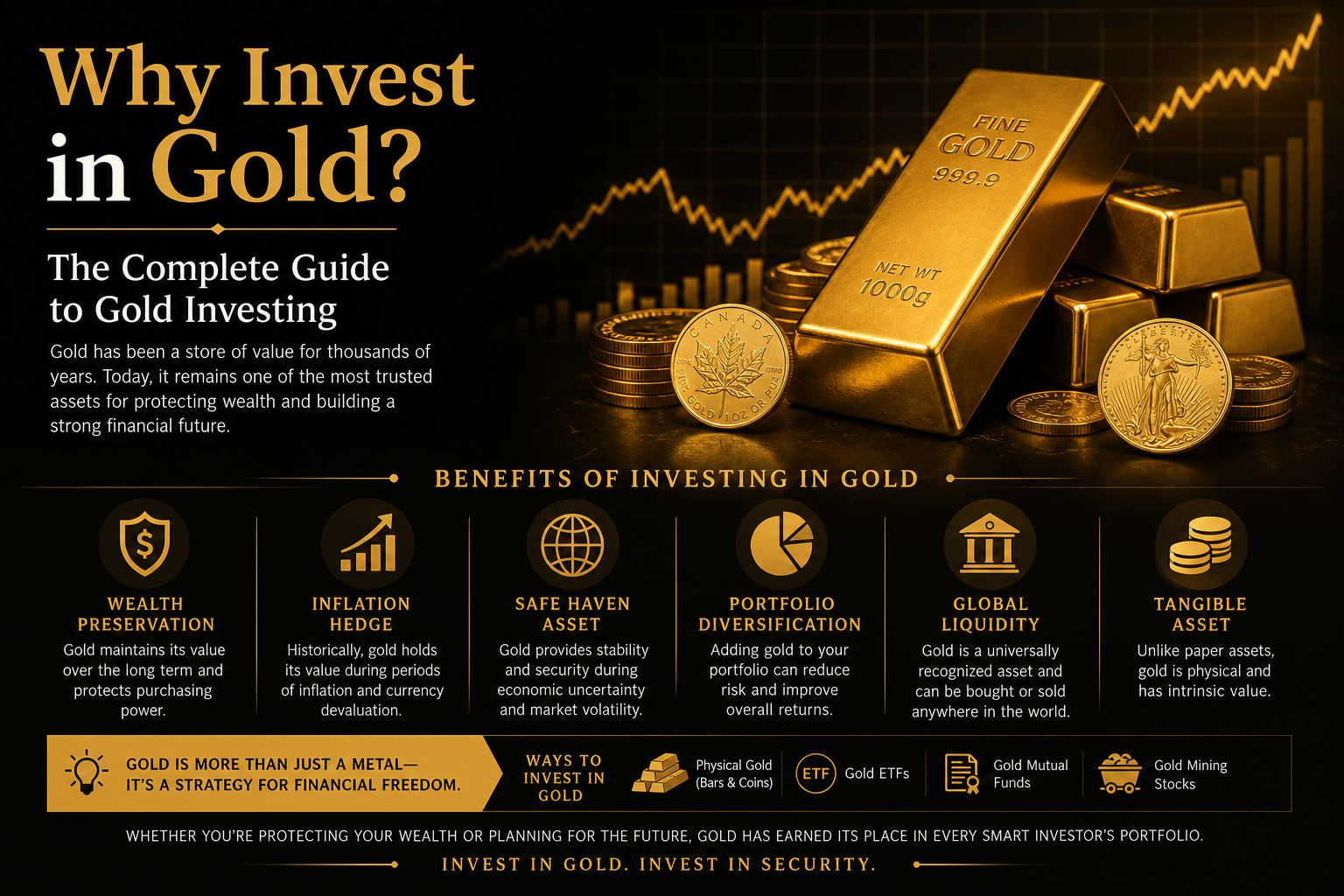
Gold has fascinated civilizations for thousands of years. It has served as money, a store of wealth, a symbol of prosperity, and a strategic reserve held by governments and central banks. Even in today’s digital economy, gold continues to play an important role in investment portfolios around the world.
Unlike paper currencies that can be created by central banks, gold is a finite natural resource. It cannot be printed, and its supply grows only gradually through mining. This scarcity, combined with its universal acceptance and long history, has helped gold retain value across generations.
For many investors, gold is more than just another asset. It can provide diversification, act as a hedge during periods of economic uncertainty, and preserve purchasing power over the long term. However, gold is not a guaranteed path to profits, nor is it suitable for every investment objective. Like any investment, it comes with both opportunities and risks.
Whether you are completely new to investing or looking to better understand the role of precious metals in a diversified portfolio, this guide will provide a solid foundation. Rather than focusing on short-term price movements, this article explains the fundamental reasons why investors continue to own gold and how it compares with other investment options.
Throughout this guide, you’ll also find links to more detailed articles that explore specific topics in greater depth.
Table of Contents
- What Is Gold Investing?
- Why Is Gold Valuable?
- The History of Gold as Money
- 10 Reasons to Invest in Gold
- Gold vs Other Investments
- Risks of Investing in Gold
- Who Should Invest in Gold?
- How to Buy Physical Gold
- Frequently Asked Questions
- Conclusion
1. What Is Gold Investing?
Gold investing refers to purchasing gold with the intention of preserving wealth, diversifying investments, or potentially benefiting from future price appreciation. Unlike buying jewellery for personal use, investment gold is typically acquired in forms designed for wealth preservation, including bullion bars, investment-grade coins, and certain financial products linked to the price of gold.
There are several ways to gain exposure to gold, each with different characteristics and levels of risk.
The most direct method is owning physical gold. Investors can purchase bullion bars or coins and store them personally or in secure vaults. Physical ownership removes dependence on financial institutions but introduces considerations such as storage, insurance, and liquidity.
Other investors choose paper or digital alternatives such as exchange-traded funds (ETFs), gold mining shares, futures contracts, or digital gold platforms. These options may provide convenience or leverage but differ significantly from owning physical bullion.
The appropriate choice depends on an investor’s objectives. Those seeking long-term wealth preservation often prefer physical gold, while traders may focus on financial products designed for shorter-term exposure.
Gold should generally be viewed as one component of a diversified investment strategy rather than a standalone solution.
2.Why Is Gold Valuable?
Gold’s value extends beyond its appearance or rarity. Several unique characteristics have contributed to its enduring role as one of the world’s most trusted stores of wealth.
Scarcity
Gold is naturally scarce. Mining companies must invest significant time, expertise, and capital to discover and extract new deposits. Annual mine production increases the global supply by only a small percentage each year, helping maintain its long-term scarcity.
Durability
Gold does not rust, corrode, or deteriorate under normal conditions. A gold coin produced hundreds or even thousands of years ago can remain virtually unchanged today.
Divisibility
Gold can be refined into bars, coins, wafers, or granules of different sizes while maintaining its intrinsic value. This makes it suitable for investors with varying budgets.
Portability
Large amounts of wealth can be stored in a relatively small quantity of gold, making transportation and storage more practical than many other tangible assets.
Universal Recognition
Gold is recognized and traded globally. Whether in Asia, Europe, North America, or the Middle East, investment-grade bullion is widely accepted and valued.
Limited Counterparty Risk
Unlike many financial assets, physical gold does not represent someone else’s liability. It is not dependent on a company’s earnings or a government’s promise to repay debt.
3.The History of Gold as Money
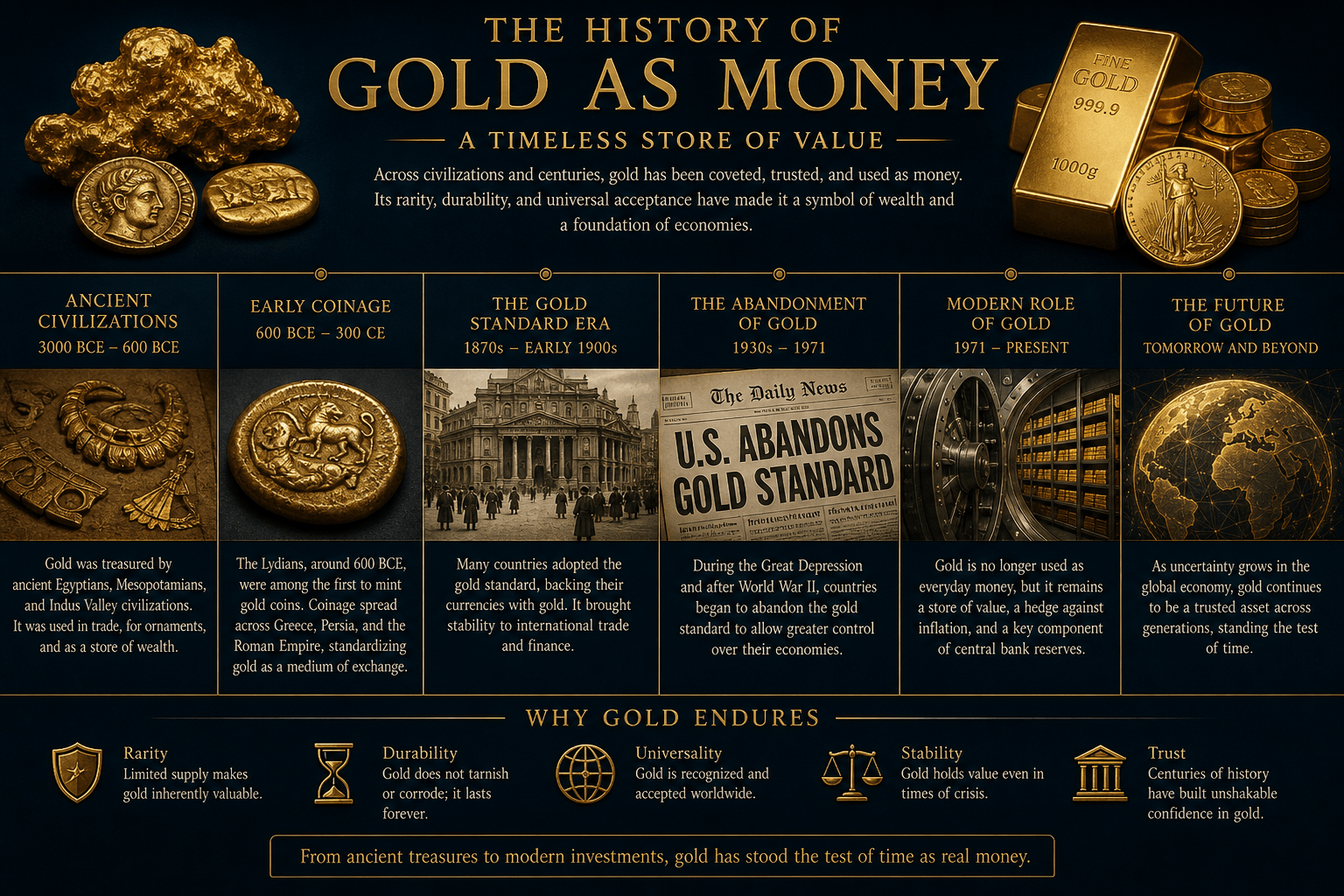
Gold has served as money for more than 2,500 years. Ancient civilizations including the Egyptians, Greeks, Persians, Romans, and Chinese all recognized gold as a valuable medium of exchange and a symbol of wealth.
As international trade expanded, gold became increasingly important because it was durable, divisible, portable, and difficult to counterfeit. Many nations eventually adopted gold standards, under which currencies were backed by specified amounts of gold.
During the nineteenth and early twentieth centuries, the international gold standard helped facilitate global trade by providing confidence in national currencies. However, the economic pressures of wars and financial crises gradually led governments to abandon direct convertibility between paper currency and gold.
In 1971, the United States ended the convertibility of the U.S. dollar into gold, marking the collapse of the Bretton Woods monetary system. Since then, most major currencies have operated under a fiat system, where money derives value primarily from government authority rather than precious metal backing.
Despite this shift, central banks continue to hold substantial gold reserves as part of their official assets. Many countries have even increased their gold holdings in recent years, highlighting gold’s continuing role in the global financial system.
Gold’s history demonstrates that while monetary systems evolve, confidence in gold has persisted through wars, inflation, recessions, and changing political landscapes.
4. Ten Reasons to Invest in Gold
Gold has remained a trusted investment for centuries because it offers characteristics that few other assets can match. While no investment is suitable for every investor or every market environment, gold can play several important roles within a diversified portfolio.

4.1. Gold Can Help Preserve Wealth
One of the primary reasons investors buy gold is its long history of preserving purchasing power over time. Unlike fiat currencies, which may lose value due to inflation or monetary expansion, gold has maintained its ability to purchase goods and services across generations. Although its market price fluctuates in the short term, many investors view gold as a long-term store of value rather than a vehicle for quick profits.
4.2. Gold Can Protect Against Inflation
Inflation reduces the purchasing power of money over time. As the prices of goods and services rise, the same amount of cash buys less than it did previously.
Historically, gold has often performed well during periods of elevated inflation because investors seek assets that cannot be created in unlimited quantities. While gold does not always move in line with inflation over shorter periods, it has frequently served as a hedge during prolonged inflationary cycles.
For investors concerned about rising living costs, gold may help offset the erosion of cash savings.
4.3. Gold Provides Portfolio Diversification
Diversification is one of the fundamental principles of investing. Holding assets that respond differently to economic conditions can reduce overall portfolio risk.
Gold often behaves differently from stocks, bonds, and property, particularly during periods of financial uncertainty. Because of this, many investors allocate a portion of their portfolios to gold to improve diversification rather than to maximise returns.
The objective is not for gold to outperform every other asset but to provide balance across different market environments.
4.4. Gold Is Considered a Safe-Haven Asset
During periods of geopolitical tension, financial crises, banking instability, or economic uncertainty, investors often seek assets that are widely trusted and highly liquid.
Gold has historically attracted increased demand during such periods because it is recognised globally and carries no direct credit risk when held physically.
Although gold prices can still fluctuate, many investors view it as a defensive asset during times of heightened uncertainty.
4.5. Gold Has No Credit or Default Risk
Many financial investments rely on another party fulfilling its obligations. Shares depend on companies remaining profitable, while bonds rely on borrowers repaying their debts.
Physical gold is different. It does not represent someone else’s promise to pay. Once owned outright, it is not subject to corporate bankruptcy or government default.
This absence of counterparty risk is one reason why central banks and institutional investors continue to hold physical gold as part of their reserves.
4.6. Gold Is Highly Liquid
Investment-grade gold is traded around the world every day. Recognised bullion bars and coins can generally be bought or sold through reputable precious metals dealers, banks, and bullion exchanges.
This global liquidity means investors can often convert gold into cash relatively quickly compared with some other physical assets, such as real estate or collectibles.
Liquidity can be particularly valuable during periods of financial stress when access to capital becomes important.
4.7. Gold Is a Globally Recognised Asset
Gold has universal acceptance unlike many investments that are tied to a specific country or financial system.
Investment-grade bullion is recognised across international markets regardless of language, political system, or currency. This global demand helps support its liquidity and makes gold a unique asset for internationally diversified investors.
Because it is traded worldwide, gold is influenced by global supply and demand rather than the performance of a single economy.
4.8. Gold Has Limited Supply
Unlike paper currencies, gold cannot be created at will. New supply depends on exploration, mining, refining, and recycling, all of which require significant time and investment.
Global mine production increases the total above-ground supply only gradually each year. This limited supply is one of the factors supporting gold’s long-term value.
4.9. Gold Is Owned by Central Banks
Central banks collectively hold tens of thousands of tonnes of gold as part of their official reserves.
These institutions maintain gold because it is widely recognised, highly liquid, and independent of any single country’s currency. In recent years, many central banks have increased their gold holdings as part of reserve diversification strategies.
While individual investors have different objectives from central banks, official ownership demonstrates gold’s continuing role within the global financial system.
4.10. Gold Can Help Preserve Wealth Across Generations
Gold has been passed between generations for centuries as a durable form of wealth.
Unlike many financial assets that depend on digital systems or changing regulations, physical gold remains a tangible asset that can be stored, inherited, or transferred relatively easily.
Many investors include gold within broader estate planning strategies as part of a diversified portfolio intended to preserve purchasing power over the long term.
Gold should not replace other investments, but it may complement them for investors seeking long-term financial resilience.
5.Gold vs Other Investments
Gold is one of many assets available to investors. Each investment serves a different purpose and comes with its own balance of risk, return, liquidity, and income potential. Rather than asking which investment is “best,” investors should consider how different assets work together within a diversified portfolio.
5.1.Gold vs Stocks
Stocks represent ownership in companies and have historically delivered higher long-term returns than gold. Investors benefit from business growth, dividends, and capital appreciation.
Gold, by contrast, does not generate income or earnings. Its primary role is wealth preservation rather than wealth creation. Gold often performs differently from equities during periods of market volatility, making it a useful diversifier rather than a replacement for stocks.
Many long-term investors choose to hold both assets—stocks for growth and gold for stability during uncertain economic conditions.
5.2.Gold vs Property
Property has long been considered a popular investment due to its potential for rental income and long-term capital appreciation. However, real estate typically requires significant capital, ongoing maintenance, taxes, insurance, and may take months to sell.
Gold offers a different set of advantages. It requires no tenants, is generally easier to buy and sell, and can be purchased in much smaller amounts. Physical bullion is also portable and does not depend on local property market conditions.
Both assets can play valuable roles within a diversified portfolio, with the choice depending on an investor’s objectives, time horizon, and liquidity needs.
5.3.Gold vs Bonds
Bonds provide investors with regular interest payments and the return of principal at maturity, assuming the issuer remains solvent. They are commonly used to generate income and reduce portfolio volatility.
Gold produces no income, but unlike bonds, it carries no credit risk when held physically. During periods of rising inflation or declining confidence in government debt, gold has sometimes outperformed bonds.
The two assets often complement one another rather than compete directly, with bonds providing income and gold offering diversification against certain economic risks.
5.4.Gold vs Silver
Gold and silver are both precious metals, but they behave differently in investment markets.
Gold is primarily held as a monetary asset and store of wealth. Its price tends to be influenced by investment demand, central bank purchases, interest rates, and macroeconomic conditions.
Silver has a dual role as both an investment metal and an important industrial commodity used in electronics, solar panels, medical equipment, and manufacturing. As a result, silver prices are often more volatile than gold.
Many precious metals investors own both metals to benefit from their different characteristics.
5.5.Gold vs Bitcoin
Gold and Bitcoin are often compared because both are viewed by some investors as alternatives to traditional fiat currencies.
Despite this comparison, they are fundamentally different assets. Gold has thousands of years of history as a store of value and is a tangible physical commodity. Bitcoin is a digital asset with a much shorter history and significantly higher price volatility.
Some investors see Bitcoin as a high-risk growth asset, while gold is generally viewed as a defensive portfolio allocation. Whether either—or both—are appropriate depends on an individual’s investment objectives, risk tolerance, and time horizon.
Learn more in our guide to Gold vs Bitcoin.
6.Risks of Investing in Gold
Although gold offers several potential benefits, it is not without risks. Investors should understand these before allocating part of their portfolio to precious metals.
One of the most important considerations is price volatility. While gold has preserved purchasing power over long periods, its market price can fluctuate significantly over months or even years. Investors seeking short-term gains may experience periods of disappointing performance.
Unlike dividend-paying stocks or income-producing property, physical gold generates no regular income. Returns depend entirely on changes in market price.
Physical ownership also involves storage and security considerations. Investors should decide whether to store gold at home, in a bank safe deposit box, or within a professional vaulting facility, each with its own costs and risks.
Finally, buying from reputable dealers is essential. Investment-grade bullion should be sourced from trusted precious metals companies to minimise the risk of counterfeit products or excessive premiums.
Gold is often most effective when viewed as one part of a diversified portfolio rather than a standalone investment.
7.Who Should Invest in Gold?
Gold may be suitable for investors seeking diversification, long-term wealth preservation, or protection against certain economic risks. It is commonly used by individuals who wish to reduce reliance on a single asset class or currency.
Investors approaching retirement may include gold as part of a broader strategy to preserve purchasing power, while younger investors may allocate a smaller percentage alongside growth-focused assets such as equities.
Gold can also appeal to investors who value tangible assets that exist outside the banking system. However, because gold does not generate income, it may be less suitable for investors whose primary objective is regular cash flow.
There is no universally correct allocation to gold. The appropriate amount depends on personal financial goals, investment horizon, and risk tolerance.
8.How to Buy Physical Gold
Buying physical gold begins with selecting a reputable bullion dealer that offers investment-grade products from recognised refiners and government mints.
Investors should first decide whether they prefer bullion bars or investment coins. Bars often offer lower premiums per ounce, while coins may provide greater flexibility for future resale.
Before purchasing, compare premiums, verify product authenticity, and understand storage options. Some investors choose home storage, while others prefer secure professional vaulting with insurance.
It is also important to understand the difference between the spot price of gold and the premium charged for manufacturing, distribution, and dealer services.
A long-term perspective is generally more important than attempting to perfectly time short-term price movements.
Learn more in our guide to [How to Buy Gold Bullion].
9.Frequently Asked Questions
9.1.Is gold a good investment?
Gold can be a useful component of a diversified portfolio, particularly for investors seeking wealth preservation and diversification. Whether it is appropriate depends on individual financial objectives and risk tolerance.
9.2.How much of my portfolio should be in gold?
There is no universal allocation. Many investors choose to hold a modest percentage of their portfolio in gold, although the appropriate amount varies depending on investment goals and market outlook.
9.3.Is physical gold better than a gold ETF?
Physical gold provides direct ownership without counterparty risk, while ETFs offer convenience and liquidity. Each approach has advantages depending on an investor’s priorities.
9.4.Does gold protect against inflation?
Gold has often maintained purchasing power over long periods and has historically performed well during some inflationary environments. However, its performance does not always move in line with inflation over shorter time frames.
9.5.When is the best time to buy gold?
Attempting to time the market is difficult. Many long-term investors use a disciplined approach, purchasing gold gradually over time rather than waiting for the “perfect” price.
9.6.Is gold taxable?
Tax treatment varies by country and jurisdiction. Investors should consult local tax regulations or seek professional advice before investing.
10.Conclusion
Gold has earned its reputation as one of the world’s most enduring investment assets. Its scarcity, durability, global acceptance, and long history as a store of value continue to make it relevant in modern investment portfolios.
While gold is unlikely to replace growth assets such as stocks or income-producing investments such as bonds and property, it can serve an important supporting role through diversification, wealth preservation, and risk management.
As with any investment, understanding both the potential benefits and the limitations is essential. Investors who take the time to learn how gold fits within a broader financial strategy are better positioned to make informed decisions that align with their long-term goals.
Whether you are considering your first bullion purchase or expanding an existing precious metals portfolio, education is the foundation of successful investing.
Disclaimer: All content is provided for informational and educational purposes only. Precious metals investments involve financial risk. Readers should conduct their own research before making any investment decisions.
