
Gold and silver experienced another highly volatile trading session on 2 October 2026, following the release of weaker-than-expected U.S. employment data.
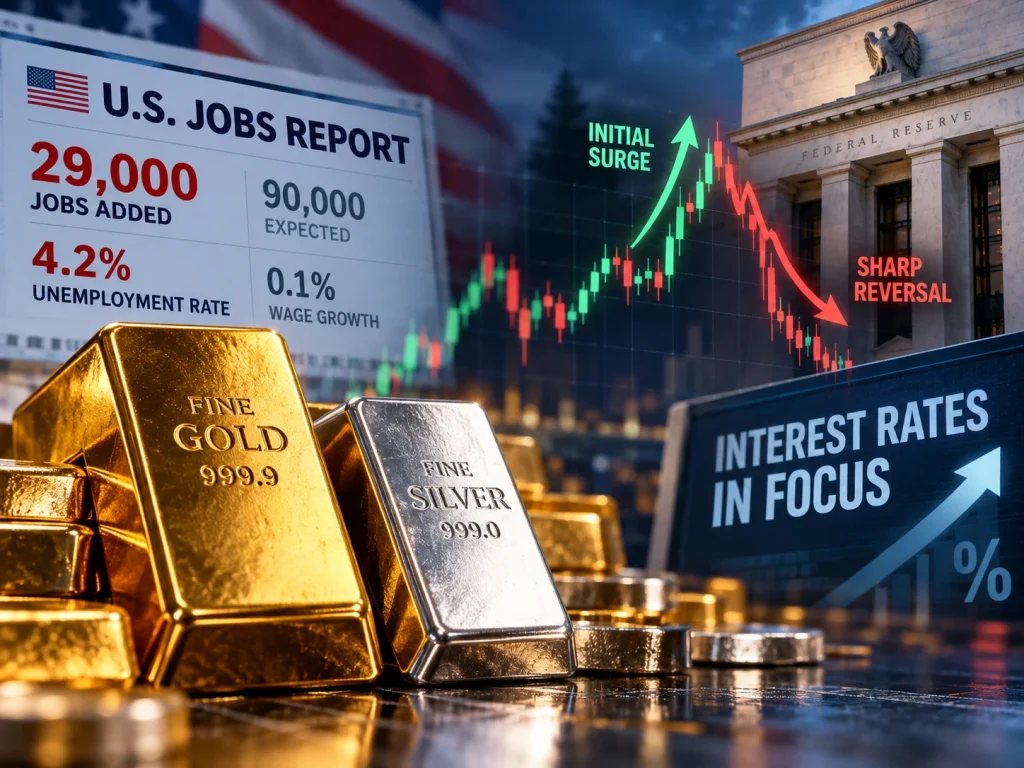
The initial reaction appeared straightforward. The disappointing jobs report sent gold and silver sharply higher as investors reduced expectations for another immediate interest-rate increase by the U.S. Federal Reserve.
However, the rally did not last.
Both metals subsequently reversed direction and ended the U.S. trading session substantially below their earlier highs. The price action demonstrated an increasingly important feature of today’s precious-metals market: economic data can trigger short-term moves, but expectations surrounding interest rates and bond yields may ultimately have a greater influence on where prices go next.
U.S. Job Growth Slows Sharply
The September employment report showed that the U.S. economy added just 29,000 nonfarm jobs, considerably below market expectations of approximately 90,000.
The unemployment rate also increased slightly to 4.2%, while average hourly earnings rose just 0.1% during the month and 3.0% compared with a year earlier.
Perhaps more importantly, previous employment figures were revised lower. July’s figure was revised from a gain of 21,000 jobs to a loss of 10,000, while August was revised from 162,000 to 133,000.
Together, July and August employment growth was revised downward by 60,000 jobs.
The figures provided further evidence that the U.S. labour market is losing momentum.
Gold and Silver Initially Surge
Precious metals initially reacted positively to the weak employment report.
Gold climbed by more than 1% during early U.S. trading, moving above US$4,200 per ounce. Silver reacted even more strongly, trading around US$61.75 per ounce, up approximately 1.45% at one stage.
The initial reaction was understandable.
A weakening labour market makes it more difficult for the Federal Reserve to continue aggressively raising interest rates. Immediately following the employment report, expectations for another rate increase at the Fed’s October meeting declined.
Lower interest-rate expectations can be favourable for precious metals because gold and silver do not generate interest. When bond yields decline, the opportunity cost of holding precious metals becomes less significant.
But what happened next was perhaps more important than the initial rally.
Gold and Silver Reverse Sharply
The gains quickly disappeared as the trading session progressed.
Gold eventually fell to around US$4,140 per ounce, finishing approximately 0.9% lower. U.S. gold futures settled at about US$4,162.
Silver followed a similar pattern, eventually falling to around US$60.36 per ounce, approximately 0.8% lower.
Gold therefore moved from above US$4,200 following the jobs report to around US$4,140 later in the session — a substantial intraday reversal.
Why did such weak employment numbers fail to produce a lasting rally?
The answer may lie with interest rates and Treasury yields.
Interest Rates Are Now Taking Centre Stage
Immediately after the jobs report, U.S. Treasury yields declined. However, that move also reversed.
By later in the session, the benchmark 10-year Treasury yield had risen to around 5.26%, while the more interest-rate-sensitive 2-year Treasury yield was around 4.82%.
This is important for gold and silver.
Investors are not simply asking whether economic data is strong or weak. They are increasingly asking a different question:
What will the Federal Reserve do with interest rates?
After the employment report, market expectations for a 0.25 percentage-point interest-rate increase at the October Fed meeting fell to roughly 21%–22%.
That is considerably lower than earlier expectations and suggests that investors increasingly expect the Federal Reserve to leave rates unchanged at its next meeting.
However, this does not necessarily mean that the interest-rate cycle is over.
Inflation remains an important concern, and the Federal Reserve raised interest rates in September for the first time since 2023. The market therefore continues to consider the possibility that further rate increases could occur later if inflation remains persistent.
Economic Data Still Matters — But Through Interest Rates
The events of 2 October provide an important lesson for precious-metals investors.
Weak employment data would traditionally be considered supportive for gold and silver. A weaker economy may encourage lower interest rates, lower bond yields and potentially a weaker U.S. dollar.
But the relationship is not automatic.
The latest jobs report was clearly weaker than expected, yet gold and silver still finished lower after initially surging.
This suggests that markets are increasingly looking beyond individual economic reports and concentrating on how those reports affect the future direction of monetary policy.
For gold and silver investors, the major factors to watch may therefore be Federal Reserve policy, inflation, Treasury yields and the U.S. dollar.
Employment, inflation and other economic statistics will remain important, but primarily because they influence expectations for interest rates.
The sharp reversal on 2 October illustrates this clearly: economic data may start the move, but interest-rate expectations can determine where the market ultimately finishes.
Disclaimer: All content is provided for informational and educational purposes only. Precious metals investments involve financial risk. Readers should conduct their own research before making any investment decisions.
