
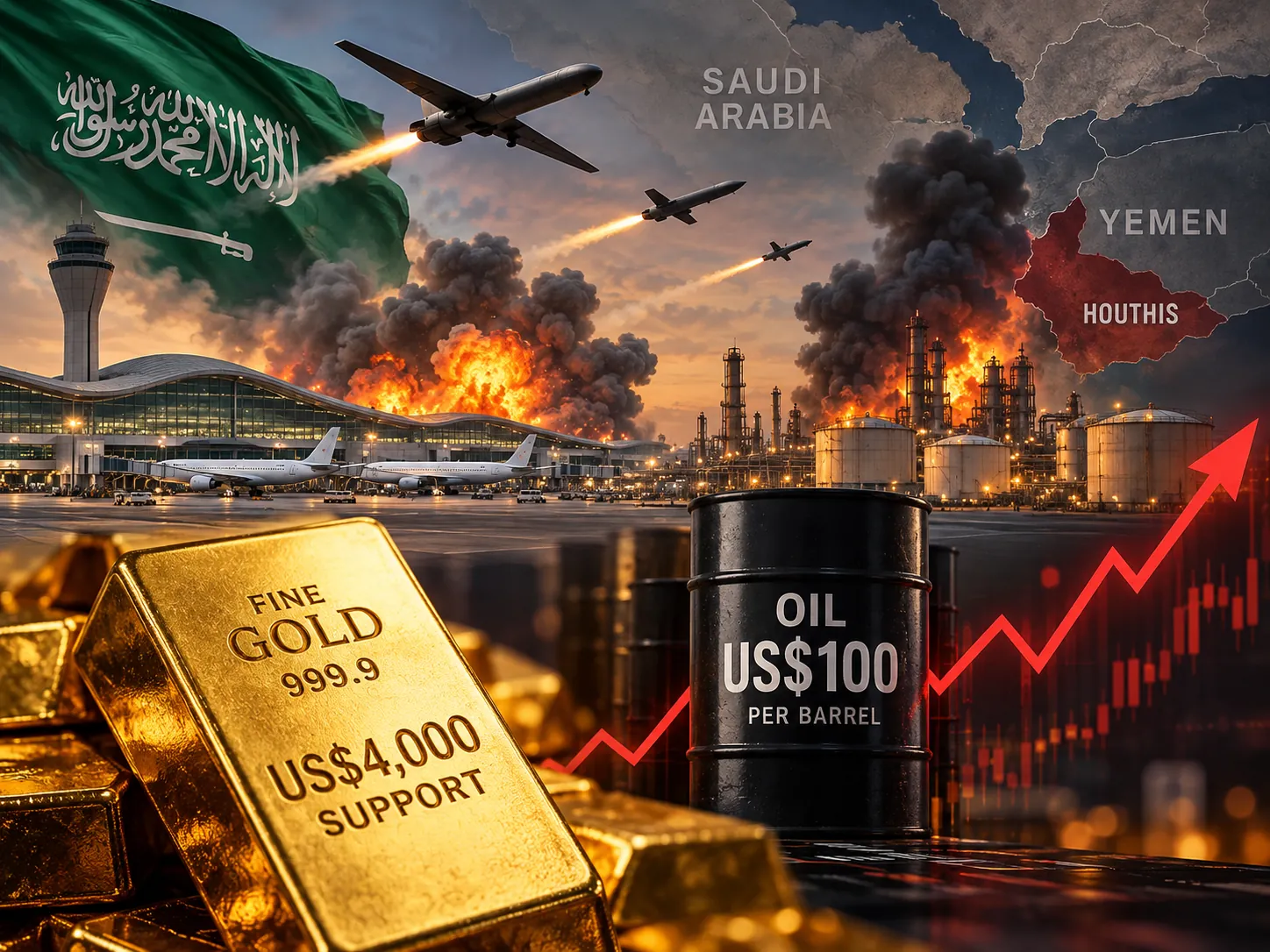
12 October 2026 – Escalating tensions between Saudi Arabia and Yemen’s Houthi movement have renewed concerns over global energy security, inflation and the outlook for interest rates. With oil prices potentially remaining near US$100 per barrel through the end of 2026, gold faces a challenging environment as investors weigh geopolitical risks against the possibility of tighter monetary policy.
Saudi–Houthi Tensions Raise Regional Security Concerns
The conflict between Saudi Arabia and Yemen’s Iran-aligned Houthi movement has intensified, with reported missile and drone attacks targeting Saudi airports and oil infrastructure. The escalation has raised concerns about the security of critical facilities and the possibility of a broader regional confrontation.
Saudi Arabia is one of the world’s largest oil exporters, making its energy infrastructure particularly important to global markets. Attacks on refineries, storage facilities and transportation networks could disrupt petroleum supplies, even if production facilities remain largely operational.
The latest confrontation also highlights the vulnerability of energy infrastructure to relatively inexpensive drones and missiles. While Saudi Arabia maintains sophisticated air defence systems, repeated attacks could increase security costs and undermine confidence in the reliability of regional energy supplies.
The situation remains fluid, with the scale and duration of any disruption likely to determine its wider economic consequences.
Oil Prices Could Remain Near US$100 Through End-2026
The escalation comes at a time when global oil markets are already sensitive to geopolitical developments.
Brent crude oil has been trading around the US$100-per-barrel level, reflecting concerns about supply disruptions and uncertainty surrounding Middle Eastern energy exports.
If hostilities continue, oil prices could remain near US$100 through the remainder of 2026. Continued attacks on Saudi energy facilities, together with risks to shipping routes in the Red Sea and the Persian Gulf, could sustain a geopolitical risk premium in crude oil prices.
However, this outlook is not guaranteed. A reduction in hostilities, increased production from other oil-exporting countries or weaker global demand could ease upward pressure.
For now, the prospect of persistently elevated energy prices presents another challenge for an already uncertain global economy.
Higher Oil Prices Could Complicate the Inflation Outlook
Sustained oil prices near US$100 could have significant implications for inflation.
Energy is a major input across transportation, manufacturing, agriculture and logistics. Higher crude oil prices generally translate into increased fuel and operating costs, which businesses may eventually pass on to consumers.
This could slow progress in bringing inflation back towards central bank targets, particularly in economies heavily dependent on imported energy.
For the United States, persistently elevated oil prices could complicate the Federal Reserve’s efforts to balance price stability with economic growth.
Although the Federal Reserve cannot directly control global oil prices, a prolonged energy shock could influence inflation expectations and make policymakers more cautious about reducing interest rates.
Should inflation remain stubbornly elevated, markets may begin pricing in the possibility of interest rates staying higher for longer, or even additional rate increases.
Inflation and Interest Rate Risks Weigh on Gold
Gold traditionally benefits from geopolitical uncertainty as investors seek assets perceived as stores of value during periods of instability.
However, the relationship between geopolitical tensions and gold prices is not always straightforward.
While the Saudi–Houthi confrontation could support safe-haven demand, rising oil prices may simultaneously create conditions that are less favourable for gold.
If higher energy costs fuel inflation and increase expectations of tighter monetary policy, U.S. Treasury yields and the dollar could strengthen.
Because gold does not generate interest income, higher bond yields increase the opportunity cost of holding the precious metal. A stronger U.S. dollar can also make gold more expensive for buyers using other currencies.
Consequently, gold could face near-term selling pressure despite heightened geopolitical risks.
The key question is whether safe-haven demand will be strong enough to offset the effects of persistent inflation and restrictive monetary policy.
Gold Needs to Defend the US$4,000 Level
Against this backdrop, the US$4,000-per-ounce level has become an important psychological support area for gold.
A sustained defence of this level could help preserve investor confidence and provide a foundation for price stabilisation.
Conversely, a decisive break below US$4,000 could weaken market sentiment and encourage further selling, particularly among technical traders and short-term investors.
Nevertheless, the US$4,000 threshold should not be viewed as an absolute floor. Technical support levels can fail when broader economic conditions change.
For gold to establish a more sustainable recovery, investors may need greater clarity on inflation trends, Federal Reserve policy and the direction of U.S. Treasury yields.
Outlook: A Difficult Balance for Gold
As 2026 approaches its final months, gold faces competing influences.
Escalating geopolitical tensions and concerns over energy security could strengthen its appeal as a safe-haven asset. At the same time, oil prices remaining near US$100 could prolong inflationary pressures and reduce the likelihood of monetary easing.
In the near term, interest rate expectations may therefore remain a more important driver of gold prices than geopolitical developments alone.
The US$4,000 level will be an important area to monitor. Gold’s ability to hold above it could influence whether the market stabilises or enters a deeper correction before year-end.
Disclaimer: All content is provided for informational and educational purposes only. Precious metals investments involve financial risk. Readers should conduct their own research before making any investment decisions.
