
Gold and silver prices staged a recovery on 29 September 2026 after suffering a sharp sell-off a day earlier, as weaker U.S. economic data provided some relief to precious metals markets. However, the rebound does not necessarily mean that the recent pressure has ended. Elevated U.S. Treasury yields, interest-rate expectations and the upcoming U.S. employment report continue to create an uncertain environment for both metals.
Sharp Sell-Off on 28 September
Gold and silver came under heavy selling pressure on Monday, 28 September, as rising U.S. Treasury yields, a stronger U.S. dollar and renewed inflation concerns weighed on non-yielding assets.
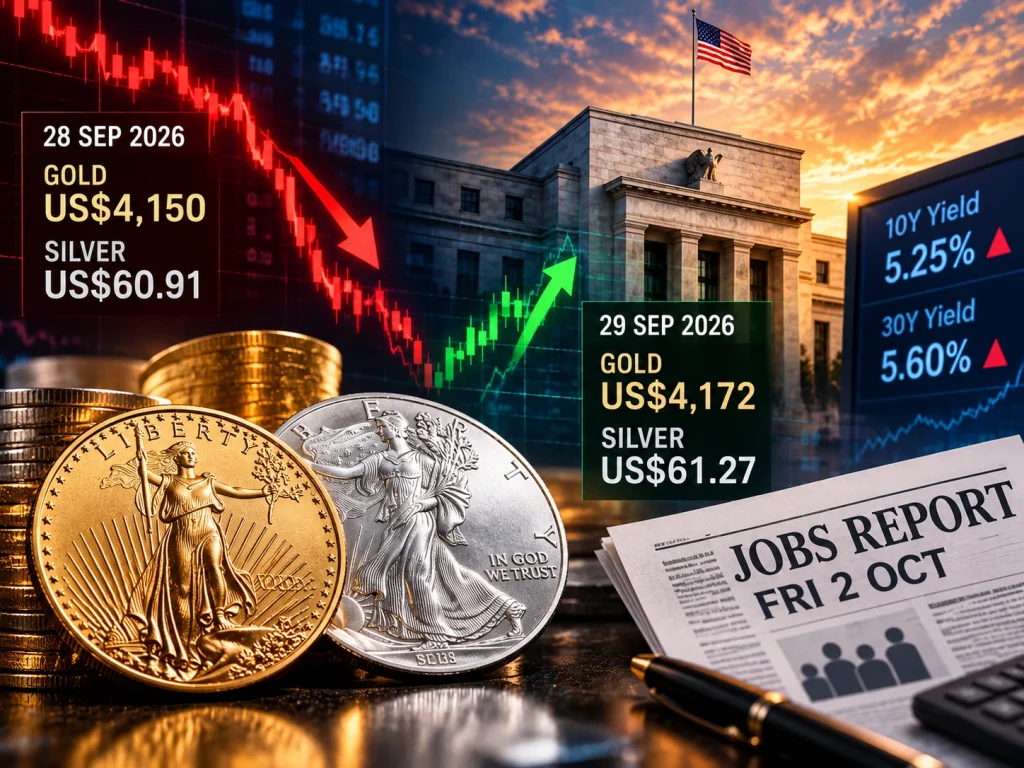
Gold traded around US$4,150 per ounce during the U.S. session, down roughly US$148 compared with the same time on the previous trading day. Silver suffered an even steeper decline, trading around US$60.91 per ounce, approximately US$3.87 lower than the previous business day.
The decline demonstrated how sensitive precious metals remain to changes in interest-rate expectations.
Unlike bonds and cash deposits, physical gold and silver do not generate interest. When government bond yields rise substantially, investors may find interest-bearing assets more attractive. Higher yields can therefore create a significant headwind for precious metals, particularly when accompanied by a stronger U.S. dollar.
Gold and Silver Recover on 29 September 2026
The picture improved on Tuesday, 29 September, following weaker-than-expected U.S. economic data.
The Conference Board’s Consumer Confidence Index dropped sharply to 81.9 in September, down from 88.6 in August. The Expectations Index, which measures consumers’ short-term outlook for income, business and labour-market conditions, also declined to 63.6.
At the same time, U.S. job openings fell to approximately 7.08 million in August, adding to signs that parts of the labour market may be cooling.
These developments helped reduce expectations for an immediate additional Federal Reserve rate increase and provided support for precious metals.
By late U.S. trading on 29 September, spot gold had recovered to around US$4,172 per ounce, gaining approximately 1.4% for the session. Spot silver rose to approximately US$61.27 per ounce, up about 1.2%.
The recovery was encouraging after Monday’s steep decline, but several important headwinds remain.
Bond Yields Remain a Major Headwind
Perhaps the biggest challenge facing gold and silver is the continued strength in U.S. Treasury yields.
On 29 September, the benchmark 10-year Treasury yield remained around 5.25%, while the 30-year yield was around 5.6%, close to levels not seen in decades.
This creates an unusual situation for gold.
Economic weakness can support gold because investors may expect the Federal Reserve to become less aggressive with interest rates. At the same time, persistent inflation — particularly if energy prices remain elevated — can keep long-term bond yields high.
Therefore, weaker economic data alone may not be sufficient to produce a sustained rally in gold and silver if bond yields remain elevated.
Friday’s Jobs Report Could Be the Next Major Catalyst
Attention now turns to the September U.S. employment report due Friday, 2 October.
The jobs report will provide another important indication of the strength of the U.S. economy and could influence expectations for the Federal Reserve’s next interest-rate decision.
A stronger-than-expected jobs report could reinforce expectations that interest rates need to remain higher, potentially pushing Treasury yields and the dollar upward. Such a reaction could create renewed pressure on gold and silver.
Conversely, weaker employment growth or an unexpected rise in unemployment could reduce expectations for further monetary tightening. That could put downward pressure on bond yields and potentially provide additional support for precious metals.
Expect Continued Volatility
The sharp decline on 28 September followed by the rebound on 29 September illustrates how quickly sentiment can change.
Gold has recovered to around the US$4,170 area, while silver has moved back above US$61, but the macroeconomic environment remains challenging.
Investors should therefore watch several factors closely: U.S. Treasury yields, the U.S. dollar, inflation, Federal Reserve policy expectations and labour-market data.
Friday’s employment report could provide the next major test.
For physical bullion investors, short-term price movements should also be viewed in perspective. Gold and silver can experience substantial volatility even when their longer-term role as tangible assets has not changed.
The rebound may have provided some relief, but with bond yields still elevated and crucial U.S. employment data approaching, the battle between interest rates and precious metals is far from over.
Disclaimer: All content is provided for informational and educational purposes only. Precious metals investments involve financial risk. Readers should conduct their own research before making any investment decisions.
