
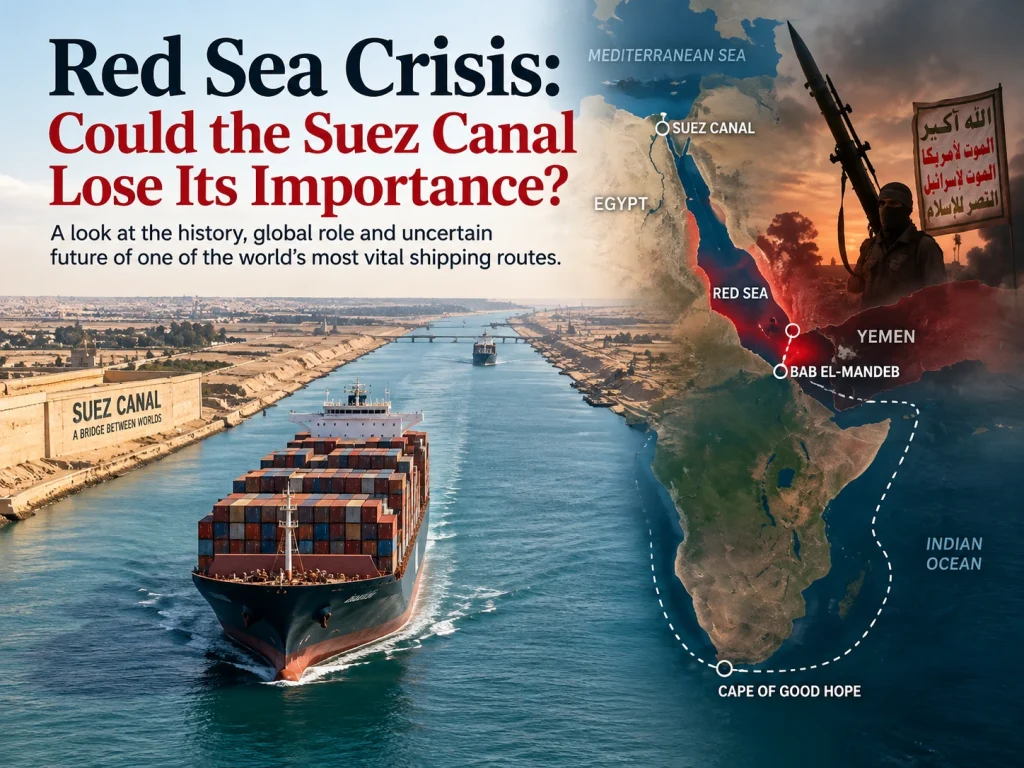
For more than 150 years, the Suez Canal has been one of the most important arteries of global shipping. By connecting the Mediterranean Sea with the Red Sea, it allows ships travelling between Europe and Asia to avoid the much longer journey around Africa.
But escalating instability in and around the Red Sea raises an important question: what happens to the Suez Canal if ships can no longer safely reach it?
If insecurity around Yemen and the Bab el-Mandeb Strait persists, more shipping companies could choose to sail around the Cape of Good Hope instead. That would have consequences not only for the Suez Canal and global trade, but potentially for inflation, energy markets and gold prices.
A Brief History of the Suez Canal
The modern Suez Canal was constructed between 1859 and 1869 under the leadership of French diplomat Ferdinand de Lesseps. It officially opened in November 1869, creating a direct maritime connection between the Mediterranean and Red Seas.
Before Suez, ships travelling between Europe and much of Asia generally had to sail around the southern tip of Africa via the Cape of Good Hope.
The canal dramatically shortened this journey and gradually became one of the world’s most strategically important shipping corridors.
Egypt nationalised the Suez Canal in 1956, triggering the Suez Crisis. The canal was later closed following the 1967 Arab-Israeli War and remained closed until 1975.
Despite wars and political upheaval, Suez has remained an essential part of global maritime trade.
Why the Suez Canal Matters to Global Shipping
The canal’s greatest advantage is simple: geography.
Ships travelling between Asia and Europe can cross the Indian Ocean, enter the Red Sea through the Bab el-Mandeb Strait, pass through the Suez Canal and emerge into the Mediterranean.
Without Suez, many vessels must travel thousands of kilometres farther around Africa.
The longer route means more fuel consumption, additional sailing time, higher operating costs and potentially fewer voyages from the same vessel over a given period.
For global supply chains built around efficiency and predictable delivery schedules, those additional days matter.
Bab el-Mandeb Is the Weak Point
The problem for Suez is that the canal does not operate in isolation.
Ships approaching from Asia must first pass through the Bab el-Mandeb Strait, the narrow waterway separating Yemen from Djibouti and Eritrea.
It is effectively the southern gateway to the Red Sea.
If commercial vessels face persistent threats from missiles, drones, attacks or seizures around this area, shipping companies may decide that the shorter Suez route is simply not worth the additional risk.
This creates an unusual situation.
The Suez Canal itself could remain completely open, yet become considerably less useful because ships are unwilling to enter the Red Sea.
Ships Can Go Around Africa
Shipping companies have an alternative: the Cape of Good Hope.
Instead of entering the Red Sea, vessels can continue around the southern tip of Africa before travelling north towards Europe.
The route is longer and generally more expensive, but shipping companies may accept those additional costs when security risks become too high.
If Red Sea instability becomes prolonged rather than temporary, shipping networks could increasingly be organised around this alternative route.
That could have significant implications for Egypt.
Fewer ships passing through Suez would mean lower transit revenues, while the canal’s strategic importance to international shipping could gradually decline.
How Could the Red Sea Crisis Affect Gold Prices?
A prolonged disruption could also have implications for gold.
Diverting ships around Africa increases sailing distances, fuel consumption, insurance expenses and transportation costs. If these higher costs are passed through global supply chains, they could contribute to inflationary pressure.
Energy markets are another consideration. The Red Sea is an important transportation corridor for oil and refined petroleum products. Serious disruption to those flows could increase energy prices, adding further pressure to inflation.
These conditions could potentially support gold.
Gold has traditionally attracted greater investor attention during periods of geopolitical uncertainty, financial instability and concern about the purchasing power of currencies. An escalating Middle East conflict combined with disruption to one of the world’s major trade routes could therefore increase safe-haven demand.
However, the relationship is not automatic.
Gold prices are also influenced by US interest rates, Treasury yields, the US dollar, central-bank purchases and broader investor sentiment. If higher inflation causes central banks to keep interest rates elevated for longer, higher yields could counter some of the support gold receives from geopolitical uncertainty.
The eventual effect on gold would therefore depend on how severe and prolonged the crisis becomes.
Could the Suez Canal Become Redundant?
Probably not — at least not completely.
The geographical advantage of the Suez Canal is simply too significant. Whenever the Red Sea is safe and accessible, shipping companies have a strong economic incentive to use the shorter route.
But prolonged instability could gradually change shipping behaviour.
If companies begin treating the Cape of Good Hope as a normal shipping route rather than an emergency diversion, Suez could lose some of its importance even without the canal itself being closed.
The consequences would extend well beyond Egypt.
Longer shipping routes could mean higher transportation costs, greater fuel consumption, supply-chain disruptions and renewed inflationary pressure. Combined with geopolitical uncertainty, these conditions could also provide additional support for gold.
The future of the Suez Canal therefore depends on more than the canal itself.
Geography makes Suez valuable. Security makes Suez usable.
And if security in the Red Sea deteriorates for an extended period, the effects could eventually be felt across global shipping, consumer prices, energy markets — and the gold market.
Disclaimer: All content is provided for informational and educational purposes only. Precious metals investments involve financial risk. Readers should conduct their own research before making any investment decisions.
