
Gold and silver recovered strongly following an initial decline after the U.S. Federal Reserve raised interest rates in September, as bargain hunting and continued safe-haven demand helped precious metals regain their footing.
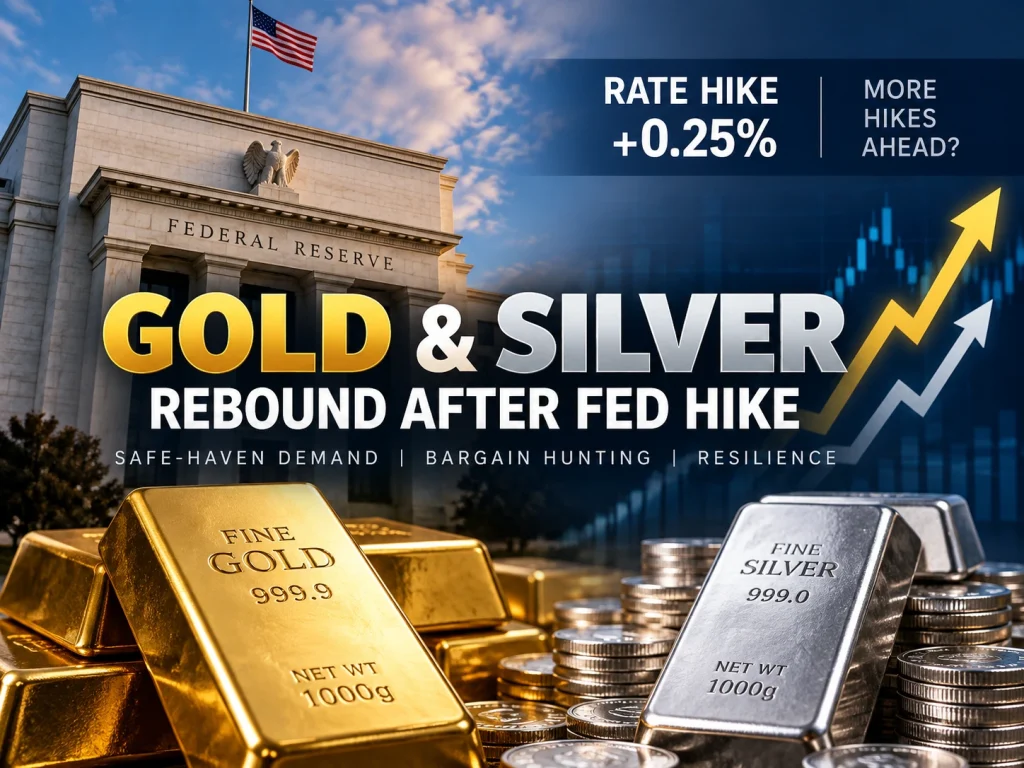
The Federal Reserve raised the federal funds rate by 25 basis points, bringing its target range to 3.75%–4.00%. More importantly for financial markets, policymakers indicated that another rate increase could still come before the end of 2026.
The Fed’s latest economic projections show a median federal funds rate of 4.1% at the end of 2026, compared with the current target range of 3.75%–4.00%. This suggests policymakers currently see room for approximately one additional quarter-point increase this year.
Inflation Remains Above Target
Persistent inflation remains one of the main reasons behind the Fed’s more restrictive stance.
The central bank now projects PCE inflation at 3.7% for 2026, while core PCE inflation — which excludes food and energy — is projected at 3.4%. Both remain well above the Fed’s longer-term 2% inflation objective.
At the same time, the Fed expects the U.S. economy to remain relatively resilient. Its September projections put real GDP growth at 2.3% in 2026, while the unemployment rate is projected at 4.1%.
These figures give policymakers some room to maintain tighter monetary conditions as they attempt to bring inflation under control.
Gold and Silver Initially Come Under Pressure
Higher interest rates would normally present a challenge for gold and silver.
Precious metals do not generate interest or income, so rising rates and higher bond yields can make interest-bearing assets such as government securities relatively more attractive. A stronger U.S. dollar can also place additional pressure on dollar-denominated gold and silver.
That pressure was evident around the Fed decision, but the weakness proved relatively short-lived.
By Friday, September 18, both metals had staged a notable recovery. Spot gold was trading around $4,382 per ounce, gaining approximately 0.85% on the day, while spot silver had climbed to approximately $66.13 per ounce, up around 1.58%.
Earlier in Friday’s session, gold traded around $4,371, while silver reached approximately $66.35, showing that buying interest had returned following the post-Fed volatility.
Bargain Hunters Return
One factor behind the recovery appears to have been bargain hunting.
Following the earlier decline, some investors and traders viewed lower precious-metal prices as an opportunity to re-enter the market. Market commentary on September 18 pointed specifically to bargain buying as providing support to both gold and silver.
The broader market environment also became somewhat more supportive. Treasury yields eased from their earlier highs during part of Friday’s session, while the U.S. dollar’s post-Fed advance lost momentum. These developments reduced some of the immediate pressure on precious metals.
Safe-Haven Demand Remains Important
Gold’s resilience also suggests that investors are looking beyond interest rates alone.
Concerns surrounding geopolitical uncertainty, persistent inflation and U.S. government finances continue to support demand for gold as a defensive asset. Gold held above $4,300 per ounce following the Fed’s decision despite higher interest rates and elevated Treasury yields.
This is important because higher interest rates have traditionally been viewed as negative for gold. The latest price action demonstrates that monetary policy is only one part of the equation.
When investors are concerned about geopolitical risks, inflation, fiscal sustainability or financial-market uncertainty, demand for safe-haven assets can remain strong even when interest rates are rising.
What Comes Next?
The Fed’s projected 4.1% year-end policy rate means precious-metals investors will continue watching incoming inflation, employment and economic data closely.
Another rate hike could create renewed pressure on gold and silver through higher bond yields and a stronger U.S. dollar. However, the strong recovery following September’s initial sell-off shows that buyers remain willing to enter the market when prices retreat.
For now, gold around $4,380 per ounce and silver around $66 per ounce demonstrate a market balancing two opposing forces: tighter U.S. monetary policy on one side, and bargain hunting and safe-haven demand on the other.
The next major question is whether those underlying sources of demand will remain strong enough to offset the possibility of another Fed rate hike before the end of 2026.
Disclaimer: All content is provided for informational and educational purposes only. Precious metals investments involve financial risk. Readers should conduct their own research before making any investment decisions.
