
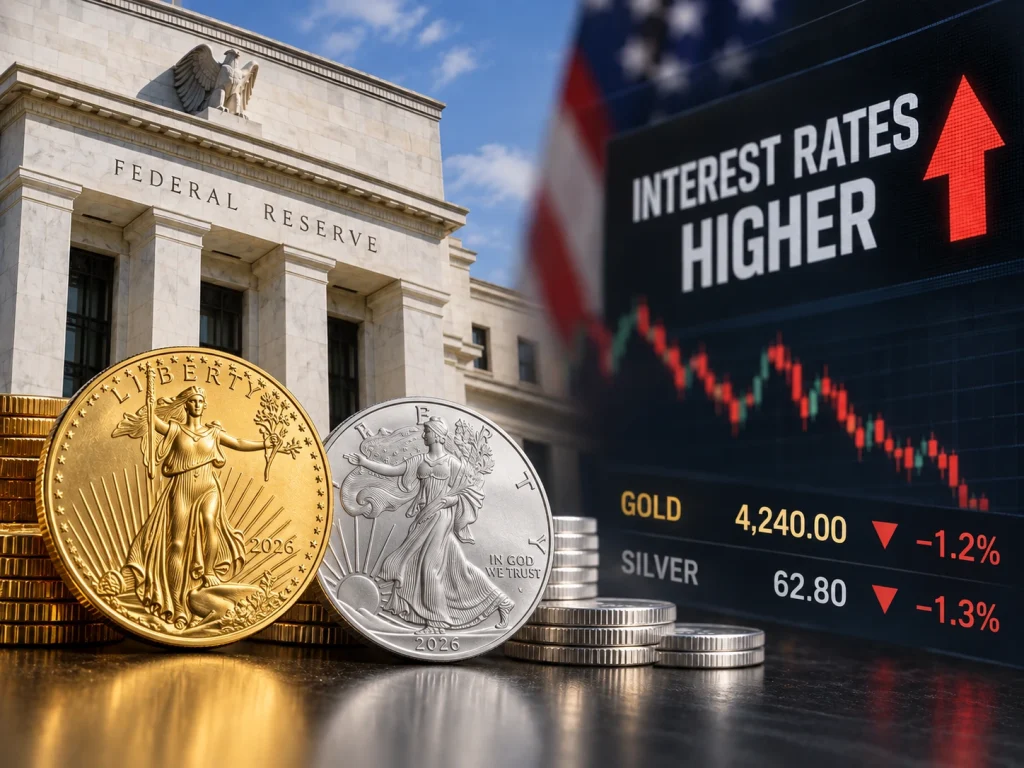
The U.S. Federal Reserve has raised interest rates for the first time in more than three years, sending a clear message that its battle against inflation is not yet over.
At its September 15–16, 2026 meeting, the Federal Open Market Committee (FOMC) unanimously voted to increase the federal funds rate by 25 basis points, lifting the target range from 3.50%–3.75% to 3.75%–4.00%.
More importantly for financial markets, the Fed indicated that the September increase may not be the last.
Inflation Remains Too High
The reason behind the renewed tightening is straightforward: inflation remains well above the Fed’s long-term 2% target.
The Fed’s latest economic projections now put PCE inflation at 3.7% for 2026, slightly higher than the 3.6% projected in June. Core PCE inflation, which excludes food and energy, is projected at 3.4%, compared with the previous forecast of 3.3%.
The Fed itself acknowledged that “inflation remains elevated” and said tighter monetary policy would support a more timely return towards its 2% objective.
These figures suggest that inflationary pressures are proving more persistent than policymakers would like, despite years of monetary tightening.
More Rate Hikes Could Be Ahead
The September rate increase may therefore mark the beginning of another period of tighter monetary policy rather than a one-off adjustment.
The Fed’s updated projections show a median federal funds rate of 4.1% at the end of 2026, up substantially from the 3.8% projected in June. The median projection remains at 4.1% for 2027, before declining to 3.9% in 2028 and 3.6% in 2029.
That 4.1% year-end projection effectively points towards at least one additional 25-basis-point rate increase before the end of 2026 if economic conditions develop broadly as policymakers expect.
For investors, this represents an important change in the interest-rate outlook.
Gold and Silver Retreat
Gold and silver reacted negatively following the Fed announcement.
Spot gold initially climbed above $4,365 per ounce before reversing sharply after the decision. It fell more than 1% to around $4,240 per ounce later in the session.
Silver also came under pressure. By late U.S. trading on September 16, spot gold was around $4,262 per ounce, down roughly 0.7%, while silver traded near $62.82 per ounce, down about 1.2%. The U.S. Dollar Index climbed towards 100.25, while the 10-year Treasury yield was around 5%.
The reaction illustrates one of the challenges precious metals face when monetary policy becomes more restrictive.
Gold and silver do not generate interest income. When interest rates and real yields rise, interest-bearing assets such as government bonds can become relatively more attractive. A stronger U.S. dollar can create additional pressure because internationally traded gold and silver become more expensive for buyers using other currencies.
Near-Term Pressure on Precious Metals
After the strong gains seen in precious metals earlier in 2026, the Fed’s renewed tightening cycle could create further volatility.
If inflation remains elevated and the Fed follows through with additional rate increases, gold and silver could remain under pressure in the near term, particularly if the U.S. dollar and real yields stay firm.
However, monetary policy is only one part of the picture.
Persistent inflation, geopolitical uncertainty, government debt, central-bank demand and concerns about long-term currency purchasing power may continue to provide support for precious metals over a longer horizon.
For now, the key message from the September Fed meeting is clear: inflation has not yet been brought fully under control, and interest rates may have further to rise.
For gold and silver investors, the next few months could therefore be shaped by a tug-of-war between tighter monetary policy and the longer-term forces that have supported demand for precious metals.
Disclaimer: All content is provided for informational and educational purposes only. Precious metals investments involve financial risk. Readers should conduct their own research before making any investment decisions.
