
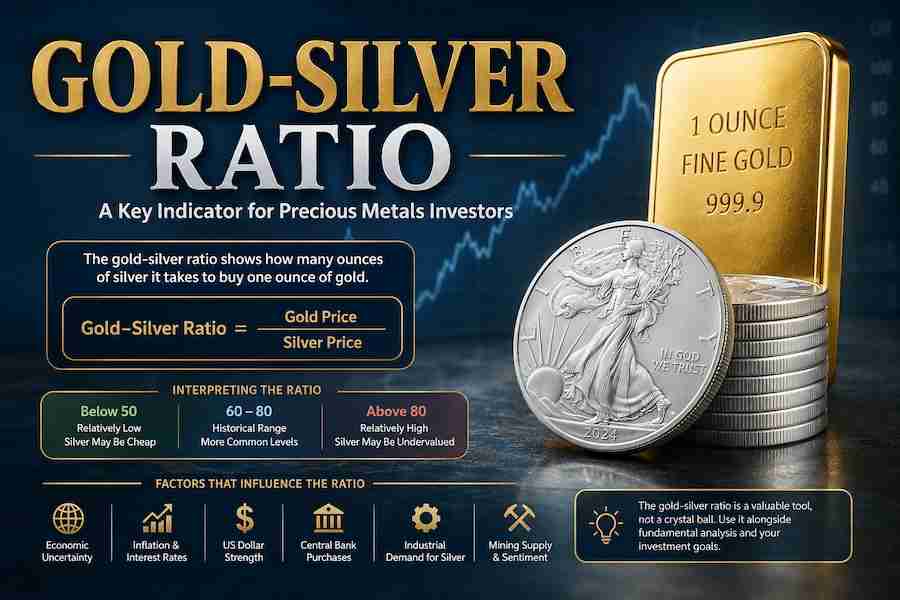
1 August 2026 – The gold-silver ratio is one of the oldest and most widely followed indicators in the precious metals market. It measures how many ounces of silver are required to buy one ounce of gold. Investors use this ratio to compare the relative value of the two metals and to identify potential buying or selling opportunities.
Unlike the price of gold or silver alone, the gold-silver ratio provides insight into whether one metal appears expensive or inexpensive compared to the other. While it should not be used as the sole investment tool, it can help investors make more informed decisions when building or rebalancing their precious metals portfolio.
What Is the Gold-Silver Ratio?
Gold-Silver Ratio = Gold Price ÷ Silver Price
For example:
Gold price: US$3,600 per ounce
Silver price: US$40 per ounce
Gold-Silver Ratio = 3,600 ÷ 40 = 90
This means it takes 90 ounces of silver to buy one ounce of gold.
The ratio changes constantly because the prices of gold and silver fluctuate throughout the trading day.
Is There an Ideal Gold-Silver Ratio?
There is no “correct” or fixed gold-silver ratio. Throughout history, the ratio has varied significantly.
Below 50 is generally considered relatively low. Between 60 and 80 has been common over many market cycles. Above 80 is often viewed as historically high.
Modern market conditions are influenced by investment demand, central bank purchases, mining production, industrial consumption, and global economic events. As a result, the ratio today can remain above or below historical averages for extended periods.
Investors should therefore view the ratio as a guide rather than a prediction.
How Investors Use the Gold-Silver Ratio
Some precious metals investors use the ratio as part of a long-term accumulation strategy.
This approach is commonly known as ratio trading or metal swapping. The goal is not necessarily to predict short-term prices but to gradually increase the amount of precious metals owned over time.
However, this strategy requires patience, discipline, and an understanding that the ratio can remain elevated or depressed for years.
Factors That Influence the Ratio
- Global economic uncertainty
- Inflation expectations
- Interest rate changes
- US dollar strength
- Central bank gold purchases
- Industrial demand for silver
- Mining supply disruptions
- Investor sentiment
Because silver has a much smaller market than gold, its price is generally more volatile. This higher volatility often causes the ratio to move sharply during periods of market stress.
Limitations of the Gold-Silver Ratio
Although the gold-silver ratio is a useful indicator, it should never be used in isolation.
The ratio does not predict future prices with certainty. A high ratio does not guarantee silver prices will rise, and a low ratio does not necessarily mean gold will outperform. Economic conditions, monetary policy, geopolitical events, and changes in industrial demand all influence precious metals prices.
Investors should combine the gold-silver ratio with fundamental analysis, market research, and their own investment objectives before making decisions.
Final Thoughts
The gold-silver ratio is a valuable tool for understanding the relationship between the world’s two most popular precious metals. By comparing the relative value of gold and silver, investors can gain additional perspective beyond simply watching price movements.
While the ratio should not be treated as a standalone buy or sell signal, it can help investors identify long-term opportunities, diversify their holdings, and make more informed portfolio decisions. Whether you are new to precious metals or an experienced investor, keeping an eye on the gold-silver ratio can provide useful insight into changing market conditions and the relative value of gold and silver over time.
The data and analysis presented in this article are compiled from official sources and industry organizations. For more information, please refer to our Sources and References page.
Disclaimer: All content is provided for informational and educational purposes only. Precious metals investments involve financial risk. Readers should conduct their own research before making any investment decisions.
