
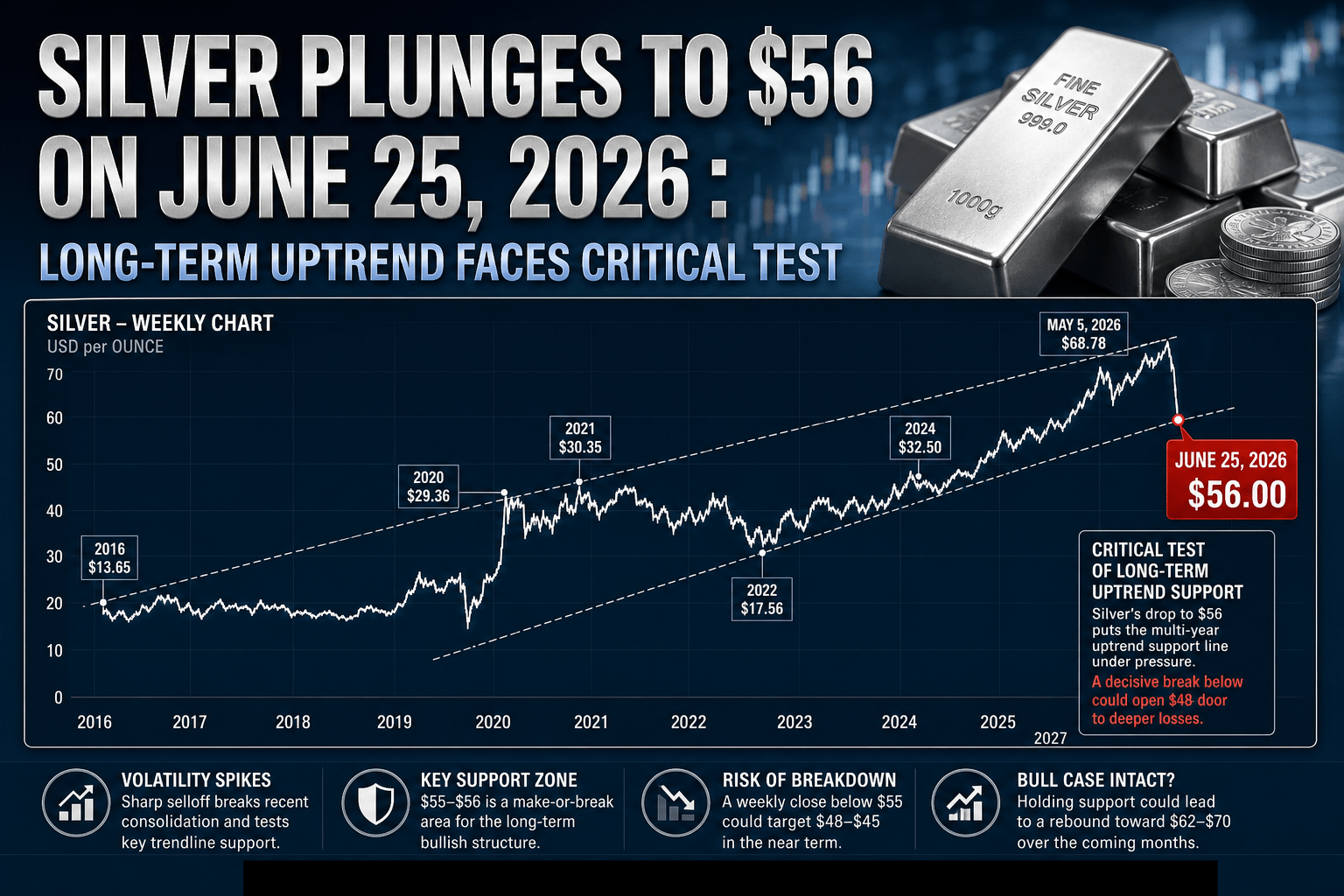
25 June 2026 – Silver prices suffered a sharp setback on June 25, 2026, falling to the $56 level as heavy technical selling swept through the precious metals market. The decline has raised concerns among investors and traders that the powerful bull market that began several years ago may be entering a critical phase.
Although silver remains significantly higher than its levels seen in 2024 and early 2025, the recent correction has damaged market sentiment and placed the long-term uptrend under pressure. Market participants are now closely watching the psychologically important $50 level, which could determine whether silver resumes its bullish trajectory or enters a deeper correction.
Technical Selling Accelerates Decline
The latest drop appears to have been driven primarily by technical factors rather than a major change in silver’s underlying fundamentals. After failing to sustain its recent highs, silver triggered a wave of stop-loss orders and profit-taking activity.
Momentum traders who had enjoyed substantial gains during silver’s powerful rally began reducing exposure as key support levels were broken. Once selling accelerated, algorithmic trading systems and leveraged positions added further downward pressure.
Such corrections are not unusual in precious metals bull markets. Silver, in particular, has historically been more volatile than gold, often experiencing sharp pullbacks before resuming its longer-term trend.
However, the speed and magnitude of the recent decline have caused investors to question whether the market is witnessing a temporary correction or the beginning of a larger trend reversal.
Why the $50 Level Matters
The $50 level carries both technical and psychological significance.
From a technical perspective, it represents a major support zone that previously acted as resistance during silver’s historic breakout. Markets often retest important breakout levels before continuing higher, making the current area a key battleground between buyers and sellers.
Psychologically, round numbers tend to attract substantial investor attention. A successful defense of the $50 level would reinforce confidence that the broader bull market remains intact. It would also encourage long-term investors to view the current weakness as a buying opportunity rather than a warning sign.
Conversely, a decisive break below $50 could trigger additional liquidation and raise the possibility of a more prolonged correction. Such a move would likely damage investor sentiment and force traders to reassess their longer-term outlook.
Long-Term Fundamentals Remain Supportive
Despite recent price weakness, several factors continue to support the long-term investment case for silver.
Industrial demand remains robust as silver plays a critical role in solar panels, electronics, electric vehicles, and advanced technologies. The global transition toward renewable energy continues to create structural demand for the metal.
At the same time, many investors still view silver as a monetary asset and a hedge against inflation, currency debasement, and financial uncertainty. Central banks around the world continue to maintain accommodative monetary policies, while government debt levels remain elevated across many major economies.
Supply constraints also remain a concern. Bringing new silver mines into production is a lengthy and capital-intensive process, limiting the industry’s ability to rapidly increase output when demand rises. These fundamental drivers have not disappeared simply because prices have experienced a sharp correction.
What Investors Should Watch Next
The coming weeks could prove decisive for silver’s medium- and long-term outlook.
First, investors should monitor whether silver can stabilize above the $50 level. A successful defense could attract bargain hunters and institutional buyers looking to accumulate positions at lower prices.
Second, trading volume will provide important clues. Strong buying activity near support levels would suggest that long-term investors remain confident in the metal’s future prospects.
Third, broader economic developments, including inflation data, interest rate expectations, and global industrial demand, will continue to influence market direction.
If silver can regain momentum and reclaim higher resistance levels, the recent decline may ultimately be remembered as a healthy correction within a continuing bull market. However, failure to hold key support could open the door to a deeper retracement.
Conclusion
Silver’s plunge to $56 on June 25, 2026, has placed the precious metal at a critical crossroads. While the long-term bullish narrative remains supported by strong industrial demand, supply constraints, and monetary uncertainty, the technical picture has weakened considerably.
The $50 level now stands as the line in the sand for silver bulls. Holding above this support would help preserve the long-term uptrend and restore investor confidence. Breaking below it, however, could signal that a more significant correction is underway.
For investors, patience and discipline remain essential as the market navigates this important test. The next move around the $50 level may determine silver’s direction for the remainder of 2026.
Disclaimer: All content is provided for informational and educational purposes only. Precious metals investments involve financial risk. Readers should conduct their own research before making any investment decisions.
