
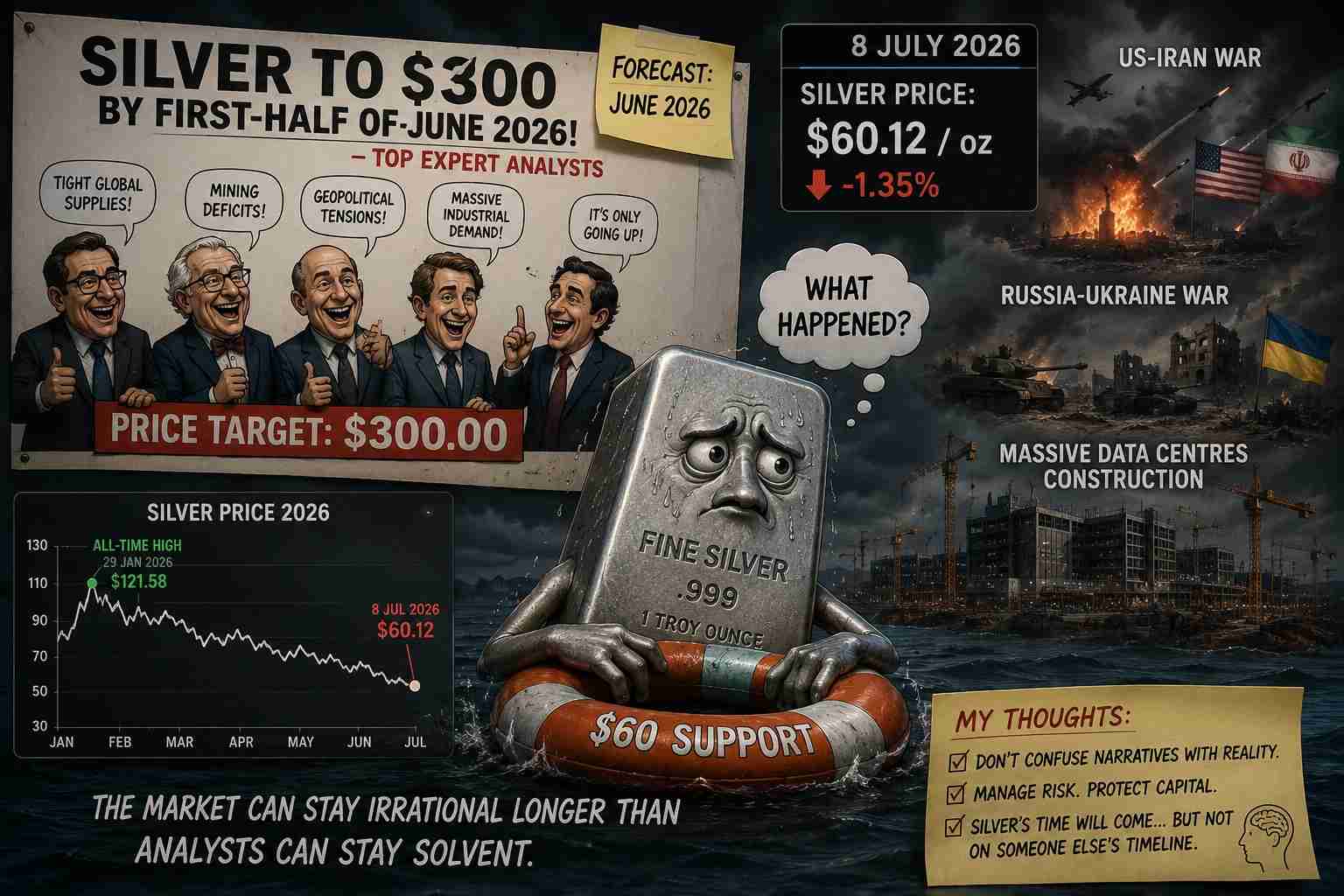
8 July 2026 – Silver has always attracted strong opinions from investors, analysts, and market commentators. During periods of economic uncertainty, silver is often viewed as both a precious metal and an industrial commodity, creating a powerful investment narrative. However, recent silver price movements highlight an important lesson: strong stories do not always translate into higher prices.
In early 2026, silver reached an all-time high of $121.58 per troy ounce on 29 January. The rally was supported by several bullish arguments, including tight global inventories, persistent mining supply deficits, rising industrial demand, geopolitical tensions, and expectations of increased consumption from renewable energy and technology sectors.
Following the price surge, some analysts and market commentators predicted that silver could reach $300 per troy ounce by the first half of June 2026. The argument was based on the belief that limited supply combined with rapidly expanding demand would create a historic shortage.
However, by 8 July 2026, silver prices were struggling to maintain levels around $60 per troy ounce. Despite ongoing geopolitical risks, including the US-Iran conflict and the Russia-Ukraine war, as well as continued investment in large-scale data centres, silver failed to follow the extreme bullish forecasts.
Why Did Silver Fail to Reach $300?
One of the biggest mistakes investors often make is confusing a compelling narrative with a guaranteed market outcome. While the factors supporting higher silver prices may be real, markets consider many variables beyond supply and demand headlines.
First, expectations may have already been priced into the market. When a large number of investors believe that silver will rise because of supply shortages or industrial demand, buying activity can push prices higher before the actual shortage occurs. Once expectations become excessive, profit-taking and selling pressure can quickly reverse the trend.
Second, commodity markets are influenced heavily by investor sentiment, liquidity, interest rates, currency movements, and economic conditions. Even if silver demand remains strong, a stronger US dollar or higher interest rates can reduce demand for precious metals as investors adjust their portfolios.
Third, industrial demand does not automatically translate into unlimited price increases. Although silver plays an important role in electronics, solar technology, and other applications, manufacturers often respond to higher prices by improving efficiency, reducing usage, or finding alternative materials.
The Difference Between Long-Term Fundamentals and Short-Term Speculation
The silver market remains supported by several long-term trends. Growing demand from renewable energy, electrification, and advanced technology could continue to create structural demand for silver. At the same time, mine supply growth remains challenging because silver production is often a by-product of other metals such as copper, lead, and zinc.
However, long-term fundamentals do not always determine short-term price movements. Markets can remain irrational in both directions, creating periods where prices move far above or below their underlying value.
Investors should be careful when evaluating extreme price predictions. Forecasts of $300 silver may generate attention, but they require extraordinary assumptions about supply shortages, investment demand, monetary conditions, and market behaviour.
What Can Investors Learn From Silver’s Volatility?
The recent silver price cycle demonstrates the importance of risk management and independent analysis. Investors should avoid making decisions based solely on headlines, social media trends, or predictions from so-called experts.
Silver may still have significant potential over the long term, but the timing and magnitude of future price movements remain uncertain. A disciplined investor focuses on valuation, portfolio allocation, and risk management rather than chasing unrealistic price targets.
Silver’s future will likely be determined not by one single factor, but by the interaction between industrial demand, mine supply, monetary policy, investor psychology, and global economic conditions.
The key lesson is simple: strong narratives can influence markets, but reality ultimately decides prices.
Disclaimer: All content is provided for informational and educational purposes only. Precious metals investments involve financial risk. Readers should conduct their own research before making any investment decisions.
