
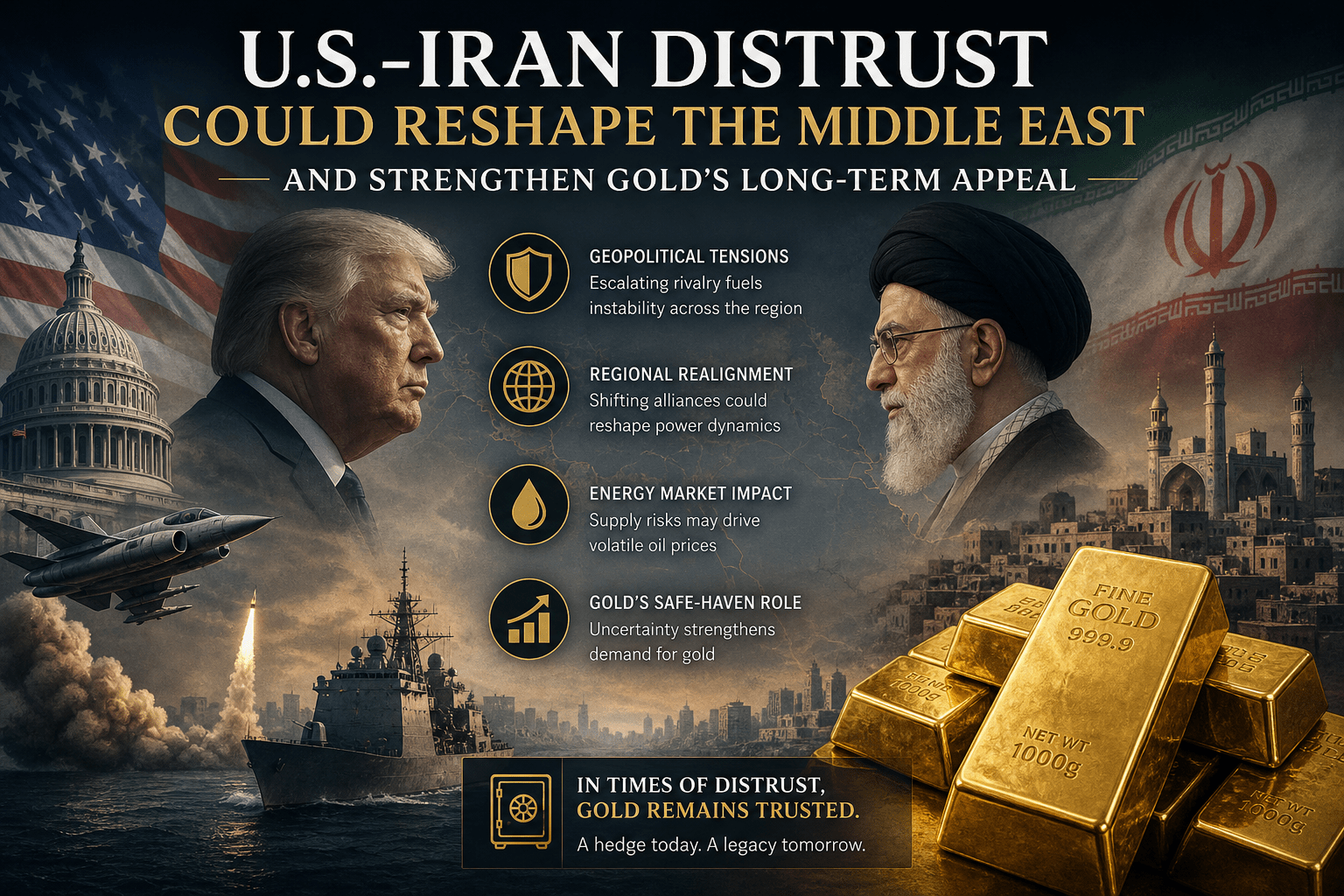
11 July 2026 – Tensions between the United States and Iran have once again become a focal point for global markets. Despite periodic diplomatic efforts and occasional signs of progress, the deep mistrust between the two countries remains a major obstacle to any lasting agreement. Decades of political confrontation, economic sanctions, and military tensions have created divisions that are unlikely to disappear anytime soon
For investors, policymakers, and governments around the world, the consequences extend far beyond the Middle East. The continued rivalry between Washington and Tehran could permanently alter regional politics while reinforcing gold’s role as a long-term store of value.
Deep Distrust Limits the Chances of an Agreement
The relationship between the United States and Iran has been strained for more than four decades. Since the Iranian Revolution in 1979, both countries have repeatedly accused one another of violating commitments and undermining regional stability. Economic sanctions imposed by the United States have severely affected Iran’s economy, while Iran’s nuclear ambitions and support for regional allies continue to alarm Washington and its partners.
Although negotiations over Iran’s nuclear program have taken place several times, the underlying lack of trust remains unresolved. From Iran’s perspective, previous agreements have failed to deliver long-term economic benefits. Meanwhile, many American policymakers remain skeptical that Iran would fully comply with any future deal.
Recent military confrontations and diplomatic disputes have only deepened these suspicions. As a result, even if temporary compromises are reached, the likelihood of a comprehensive and durable agreement in the near future appears low.
Without mutual confidence, both sides are likely to continue pursuing policies designed to protect their strategic interests rather than seeking meaningful reconciliation.
A Potential Turning Point for Middle Eastern Politics
The ongoing confrontation between the United States and Iran could reshape the political landscape of the Middle East for years to come. Countries across the region are already adjusting their foreign policies in response to shifting alliances and growing uncertainty.
The ongoing confrontation between the United States and Iran could reshape the political landscape of the Middle East for years to come. Countries across the region are already adjusting their foreign policies in response to shifting alliances and growing uncertainty.
At the same time, Iran continues to expand its influence through political and military partnerships across the Middle East. This evolving balance of power may redefine security arrangements, trade relationships, and energy policies throughout the region.
The consequences could be significant. A prolonged period of instability may encourage countries to diversify their economies, reduce dependence on foreign powers, and pursue new strategic alliances. In this sense, the current tensions may not simply represent another chapter in a long-running dispute—they could mark the beginning of a new political era in the Middle East.
Why Gold Stands to Benefit
Periods of geopolitical uncertainty have historically increased demand for safe-haven assets, and gold remains one of the most important among them. Investors typically turn to gold during times of conflict because it is viewed as a reliable store of value that is largely independent of any single government or currency.
The uncertainty surrounding U.S.-Iran relations creates several conditions that support higher gold prices over the long term. First, persistent tensions raise concerns about potential disruptions to global energy markets, particularly oil supplies from the Middle East. Rising energy costs can contribute to inflation, which often boosts demand for precious metals.
Second, geopolitical instability encourages central banks and institutional investors to diversify their reserves away from traditional financial assets. In recent years, many central banks around the world have steadily increased their gold holdings, reflecting a broader desire for financial security.
Finally, the absence of a clear diplomatic solution means that markets are likely to experience recurring periods of volatility. Every new round of negotiations, sanctions, or military developments has the potential to trigger fresh demand for gold.
While short-term price fluctuations are inevitable, the long-term outlook for gold remains supported by the uncertain relationship between the United States and Iran. As distrust continues to shape the geopolitical landscape, gold may increasingly serve as a strategic asset for investors seeking stability in an unpredictable world.
Disclaimer: All content is provided for informational and educational purposes only. Precious metals investments involve financial risk. Readers should conduct their own research before making any investment decisions.
